
Fifth-Wave Universities: IAUP Conference Held in Central Asia for the First Time

More than 100 university heads, representatives of international organizations, and members of the expert community from over 15 countries – including Central Asia, Europe, North America, and the Asia-Pacific region – gathered in Almaty to participate in the first-ever IAUP (International Association of University Presidents) Regional Conference in Central Asia. The IAUP is one of the world's largest global networks of higher education executives, bringing together university leaders from more than 120 countries.

The event was organized by Almaty Management University (AlmaU) together with the IAUP, in partnership with the Ministry of Science and Higher Education of the Republic of Kazakhstan, The Phoenix Philanthropy Group, the British Council, QS Quacquarelli Symonds, the Eurasian Chapter of Principles for Responsible Management Education (PRME), and the Almaty Tourism Bureau. Modern Education magazine acted as one of the media partners for the event.
Sayasat Nurbek, Minister of Science and Higher Education, delivered an online welcoming address. First and foremost, he spoke about the ongoing work to transform Kazakhstani universities into research institutions, citing the strategic partnership between M. Kozybayev North Kazakhstan University (NKU) and the University of Arizona, under which three large-scale projects are being implemented.
He also focused on the AI-Sana program, under which all Kazakhstani undergraduate students have undergone AI training. Every student must have access to AI and the opportunity to multiply their productivity, the minister said.
In parallel, a partnership with OpenAI is being carried out: one hundred percent of managers and most of the teaching staff receive licenses for ChatGPT, in its specialized professional version, so that teachers can create educational materials and conduct educational programs with the help of artificial intelligence.
"For impact-driven universities, affecting the life of society is a central task. We are at the center of a rapidly changing region, and we expect that Kazakhstani universities will become a source of change; we count on their active leadership positions in the research sphere," noted Sayasat Nurbek.
The holding of conferences and the signing of agreements must yield visible results, the minister said, wishing the participants to reach concrete agreements and emphasizing that the region's universities are ready for this.
Asylbek Kozhakhmetov, Founder and President of AlmaU, spoke about the long journey the university has undertaken. This is also the path that Central Asia has traveled over the past decades, during which an entire generation of reformers built a new quality control system from scratch, internationalized educational programs, and established partnerships. Today, universities from five continents have gathered here in Kazakhstan to discuss global challenges in education.
About 80 million young people live in Central Asia. Much remains to be done to ensure they receive their education at home and stay to work and conduct research in an environment created for this purpose. The responsibility of higher education to society, Asylbek Kozhakhmetov noted, lies in the impact that universities have not only on their immediate surroundings, but on the entire life of society and on civilization.
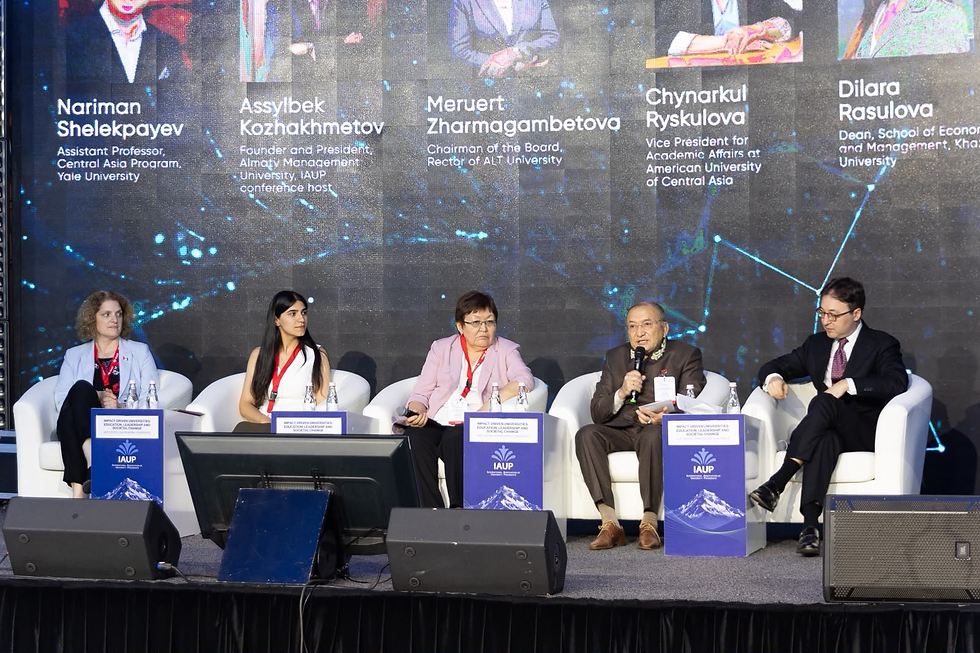
he presentations and panel sessions were held at a high intellectual level, with the role of universities in society discussed from various perspectives—including social, environmental, educational, and many others.
Norbert Csizmadia, an expert in geopolitics and geoeconomics, presented his concept of a "turquoise" future. He argued that the main vector of civilization's development in the Anthropocene epoch should not be economic competition or GDP growth, but global connectivity, quality of life, peace, and a balance between nature, culture, and knowledge. "Turquoise zones" are territories where human beings and nature interact harmoniously, bringing together talent, technology, and capital. A special role in this process is to be played by fifth-wave universities, whose mission is to serve both society as a whole and the environment. The scholar highly praised the event, calling Almaty the new heartland.

The panel sessions sparked discussions on several pressing issues facing higher education.
The first topic centered on rankings and accreditation. Participants discussed the need for a balance between striving to meet global standards and the actual social contribution of universities. They noted that international accreditations and rankings measure only easily accessible technical metrics, missing the harder-to-measure social impact and regional needs; at the same time, however, high ranking positions enhance an institution's attractiveness to top-tier applicants.
Next, the focus shifted to the ability of higher education institutions to graduate the specialists that businesses actually expect. Traditional, lecture-based universities cannot keep pace with the market. Meanwhile, by 2030, most professions will change and many new ones will emerge. The primary solution identified was a transition from theory to practice through the integration of business into education, dual training, and lifelong learning. Universities must bridge the gap between education and real life, transforming into entrepreneurial hubs, while the focus of teaching must shift toward developing critical thinking, adaptability, and soft skills.

To transform the region into a scientific and educational hub, we can rely on our own deep Turkic traditions and avoid blindly copying Western standards, participants from Central Asian countries noted. Universities must simultaneously be guardians of tradition and creators of the future. Cultural identity will be preserved to the extent that it is integrated into educational programs.
At the end of the first day, a book launch was held for Universities After AI, published in English with a foreword by Sayasat Nurbek, the Minister of Science and Higher Education of the Republic of Kazakhstan. The collection includes analytical papers by experts from various countries on what becomes most critical in the era of artificial intelligence and technology for building a sustainable future.
The second day took place at AlmaU University, where discussions on current topics continued. The conference provided a unique opportunity to shape a shared regional vision for the role of universities in the modern world and to contribute to the global discourse on the future of higher education.

Comments