
Sustainable Development In Global Engagement:International Strategy of Kh. Dosmukhamedov Atyrau University


Kh. Dosmukhamedov Atyrau University, which trains specialists and conducts research across a wide range of fields, from pedagogy to business analytics, ensures the high qualifications of its graduates and creates new opportunities for students, faculty, and researchers, strengthening its position in the international educational space and expanding partnerships with leading foreign universities and international organizations. It is a member of regional and global consortia and associations, promotes the environmental agenda, and is one of the models of campus sustainability. Salamat IDRISOV, Chairman of the Management Board and Rector of the university, shared with our journal the university's latest achievements, principles, and development strategy, as well as its plans for the future.
– Salamat Nurmukhanovich, internationalization is becoming one of the strategic priorities of Kazakhstan’s universities today. How extensive is this work at Kh. Dosmukhamedov Atyrau University? Who are your foreign partners?
– I think the place we give to this work is clearly shown by the fact that the university's management board includes a Vice-Rector for Strategic Development and Internationalization. To date, the university has concluded more than 150 international agreements with universities and scientific and educational organizations around the world. Our cooperation covers the USA, France, Poland, the Republic of Korea, Malaysia, China, Türkiye, Hong Kong (PRC), the CIS countries, and other states.
In the past academic year alone, we signed 40 new agreements. We are continuing to establish ties with Hebi Polytechnic University (China) and are negotiating cooperation with the Saints Cyril and Methodius University of Skopje (UKIM, Republic of North Macedonia), as well as with a number of other universities in Europe and around the world.
Cooperation with universities of the Republic of Türkiye is developing widely. We have agreements with Fırat University, Çankırı Karatekin University, Kütahya Dumlupınar University, Hatay Mustafa Kemal University, and TED University, aimed at developing academic mobility and joint educational and research projects.
One of the university's most significant achievements of the 2025–2026 academic year was obtaining the status of an associate member of the Agence Universitaire de la Francophonie (AUF).

Joining AUF has opened new opportunities for the university to take part in international educational and scientific initiatives, grant competitions, academic mobility programs, joint research projects, international conferences, and other events held under the Agency's auspices.
The university is currently building its cooperation with AUF in several directions. One of the nearest significant events will be the AUF Regional Conference of Rectors, to which Atyrau University has received an official invitation. Participation in the conference will allow the university to establish new professional contacts and discuss prospects for joint scientific and educational projects, expanded academic mobility, participation in international grant programs, and further development of cooperation with universities of the Francophone world.
– An important direction of the university's internationalization is attracting foreign scholars and instructors to its educational and research activities. Who of foreign professors teach at your university?
– Under the program of the Ministry of Science and Higher Education of the Republic of Kazakhstan for attracting foreign scholars, in the 2025–2026 academic year researchers from Akdeniz University (Türkiye), Vytautas Magnus University (Lithuania), the University of Guilan (Iran), and the Gdańsk University of Tourism and Hospitality (Poland) visited Atyrau University. Their stay at our university was productive: they gave lectures, seminars, master classes, and academic consultations, and took part in joint scientific and educational events.
In addition, in the past academic year, under the ORHUN Academic Mobility Program, the university hosted Mustafa Kemal Gümüş from Artvin Çoruh University (Republic of Türkiye). His visit included lectures and an exchange of experience and was aimed at developing academic interaction between the faculty of our universities and strengthening cooperation within the network of universities of the Turkic states.

We are currently continuing to expand international academic cooperation and are working on inviting foreign professors and researchers from the University of Helsinki (Finland), the University of Bristol (United Kingdom), the University of Technology and Applied Sciences – Ibra (Sultanate of Oman), the Royal College of Surgeons in Ireland – Bahrain (Kingdom of Bahrain), Lund University (Sweden), and other leading foreign universities to give lectures and scientific seminars, conduct joint research, and develop long-term international cooperation.
– Kh. Dosmukhamedov Atyrau University is an active participant of the Association of State Universities of the Caspian States. Could you tell us about this consortium. What are its goals?
– The Association of State Universities of the Caspian States, founded in 1996, brings together 64 universities and research centers from Azerbaijan, Iran, Kazakhstan, Russia, and Turkmenistan. Its work is aimed at creating a unified scientific and educational space in the Caspian region and developing joint research, and, definitely, first and foremost at finding effective solutions to the environmental and technological challenges of the Caspian region.

The Association members organize exchanges of experience between scholars and instructors, carry out international educational initiatives, and strengthen academic ties between universities. The organization has memoranda of cooperation with associations of universities in Europe, Asia, and the Middle East, and participation in international grant programs such as Erasmus+, Horizon Europe, GreenCentral Asia, and others is under discussion.
In 2025, the XXVII General Assembly of the Association of State Universities of the Caspian States, devoted to the Caspian ecosystem, was held at our university. It discussed prospects for the region's sustainable development, expansion of scientific cooperation, training of a new generation of researchers and specialists, continued implementation of academic mobility programs, and development of new joint educational programs.
At the 2026 Assembly, held in early October, the results of our university’s chairmanship of the Association were summed up. During this period, a number of important projects were carried out on our initiative, aimed at strengthening scientific and educational cooperation, developing academic mobility, expanding joint research, and addressing the environmental problems of the Caspian region.
In particular, international scientific meetings and forums were organized, and initiatives were proposed such as the “Caspian Campus,” the Caspian Research Consortium, and “The Caspian: A Space of Cultural Dialogue.” Special attention was also given to developing artificial intelligence technologies and expanding scientific cooperation in fisheries and aquaculture.

This work was continued by the participation of the Vice-Rector for the Strategic Development and Internationalization in the international conference “Sustainable Development in Eurasia,” held on May 29, 2026, in Astana. The conference discussed achieving the Sustainable Development Goals, strengthening regional cooperation, implementing joint research projects, developing academic mobility, and expanding interaction between the universities of the Eurasian space. Participation in this conference resulted in new professional contacts and the identification of promising areas for further international cooperation.
We pay particular attention to the development of scientific research aimed at solving pressing problems of the Caspian region. A number of major scientific projects are currently under way in the fields of sustainable development, ecology, and rational use of natural resources.
Among the most significant are the project “Caspian Center for Sustainable Innovation: Scientific and Academic Promotion of Alternative Solutions for the Region's Transition to a Greener Future”; a project on using artificial intelligence and machine learning technologies to achieve the Sustainable Development Goals in safe water supply, sanitation, and water resources management; and research aimed at developing innovative materials to address the region's environmental and infrastructure challenges.
The fishing industry is an important part of the economy of the Caspian region. In autumn 2025, our university held a seminar on trends and innovations in the fishing industry, where we presented the results of the university delegation's participation in the international forum Global Fishery Forum & Seafood Expo Russia (Saint Petersburg, the Russian Federation). We discussed current trends in the development of the fishing industry, prospects for training personnel, developing scientific cooperation, implementing double-degree and academic mobility programs with foreign universities, and further interaction with enterprises in the fishing sector.

– In 2026, Kh. Dosmukhamedov Atyrau University ranked 590th in the international UI GreenMetric World University Rankings among 2,016 universities worldwide, rising almost 100 places in a year. Among the 41 Kazakhstan’s higher education institutions included in the ranking, the university took 7th place, confirming its status as one of Kazakhstan's leading universities in the sustainable development and environmental responsibility. What is your strategy in this area?
– This result is the outcome of consistent implementation of the university's Sustainable Development Strategy, which is based on the UN Sustainable Development Goals, ESG principles, and the Green Campus concept. The university has built a comprehensive sustainability management system covering infrastructure development, education, scientific research, digital transformation, international cooperation, and engagement with society.
One of the key areas is the development of modern environmental infrastructure. The green area on the territory of Atyrau University is steadily growing, and work is under way on campus landscaping, planting of trees and ornamental plants, and creating comfortable public spaces.
Particular attention is paid to creating a barrier-free educational environment: academic buildings are equipped with ramps, automatic entrance doors, specialized sanitary rooms, and tactile navigation maps, and the “Daryn” Inclusive Support Center is in operation.
To ensure a safe educational environment, modern video surveillance and access control systems and round-the-clock security have been introduced.
An important part of the university's environmental policy is improving energy efficiency and using renewable energy sources.
Since 2017, the university has been implementing green energy projects. The campus has the Solar Gazebo 360, equipped with an automatic sun-tracking system and used as a recreation area and charging station. The innovative Solar Wind Tree complex has also been installed, combining solar and wind generation and producing up to 6 kWh of electricity per day to light the campus's public spaces.
At the same time, we are gradually converting the lighting system to LED technology and introducing energy-saving solutions and intelligent energy management systems. Substantial resource savings are achieved through the digitalization of educational and administrative processes using the platforms AI SANA, Platonus, and LIBAU Digital Library, an electronic document management system, corporate e-mail, and the MOOC online platform. This significantly reduces paper use and improves the efficiency of resource.
The comprehensive waste management system is based on the principles of waste reduction, separate collection, reuse, and recycling. Containers for separate collection of paper and plastic have been placed across the university, and environmental campaigns, Green Campus initiatives, student environmental projects, and events of the national “Taza Qazaqstan” program are held regularly.
The university's research teams are developing innovative technologies for recycling industrial sulfur waste into environmentally safe building materials and are also exploring the use of cigarette butts in the manufacture of building blocks and paving tiles, which promotes circular economy principles and reduces the negative impact of waste on the environment.
Rational use of water resources is one of the priorities of the university's environmental policy.
To reduce water consumption, the campus has introduced a drip irrigation system for green spaces, allowing water to be used efficiently in landscaping. Academic buildings are fitted with sensor faucets that automatically regulate water flow and reduce consumption.
At the same time, water consumption is continuously monitored, utility networks are being modernized, and measures are being taken to prevent water losses. The university's research is also aimed at ensuring water safety, sustainable water resources management, and achieving Sustainable Development Goal No. 6.

– Research at your university plays a special role in achieving the UN Sustainable Development Goals. How is it organized?
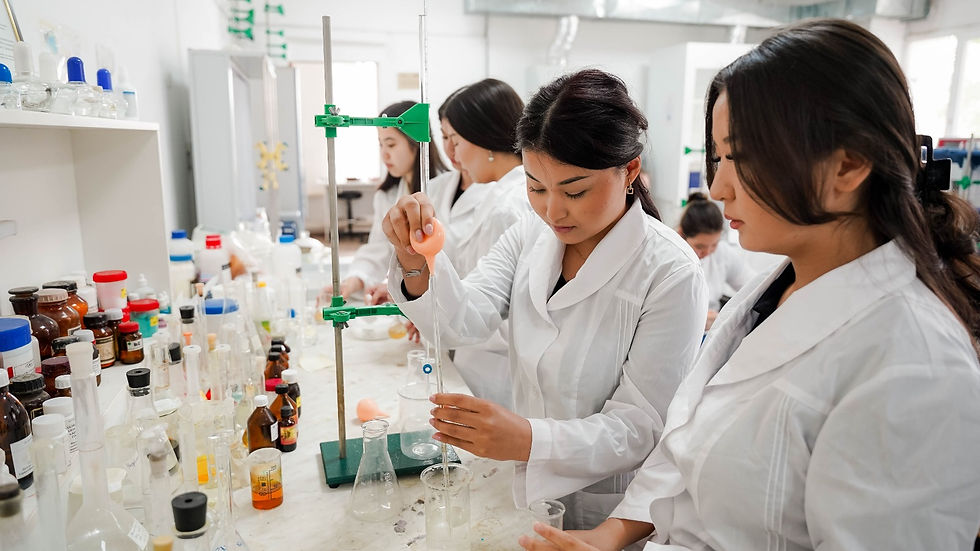
– The university has the Research Institute “Ecology, Bio- and Nanotechnology,” whose main purpose is to conduct fundamental and applied research aimed at implementing the principles of the environmentally sustainable development, developing innovative solutions, and applying scientific results in industry, agriculture, and education.
The institute includes the Scientific and Production Center “Biology, Geoecology and Grass Production in Arid Conditions,” the Research Laboratory “Biotechnology,” and the Laboratory for Comprehensive Research and Environmental Monitoring “Caspian,” which do research on environmental monitoring, biodiversity conservation, bioremediation, rational use of natural resources, and the development of environmentally safe technologies.
The university's research is focused on solving pressing sustainable development problems and covers ecology, climate change, digital technologies, resource conservation, and environmental protection.
Among the most significant projects are “Using Artificial Intelligence and Machine Learning to Achieve the Sustainable Development Goal of Ensuring Safe Water and Sanitation in Kazakhstan”; “Development of the Fundamentals for Creating Sustainable Asphalt Concrete Pavements Using Secondary Polymers and Lignin to Address Environmental and Infrastructure Problems”; and the program-targeted project “Caspian Center for Sustainable Innovation: Scientific and Academic Promotion of Alternative Solutions for the Region's Transition to a Greener Future,” already mentioned above.
In addition, we conduct research on artificial intelligence, the digitalization of education, sustainable pasture use, environmental monitoring, and the sustainable development of the Caspian region.

– Training highly qualified specialists is an integral part of a sustainable development strategy. How is the green agenda built into the educational process? Do young people show their own initiative and propose ideas for improving the environment of the Caspian region?
– Many of our programs are connected with this area: “Applied Ecology,” “Ecoanalytics,” “Waste Management,” “Biology,” “Geography,” “Chemical Analysis and Expertise,” “Fisheries and Ichthyology,” “Applied Mathematical Modeling,” and teacher-training programs in biology, chemistry, geography, physics, mathematics, and natural science.
Educational programs incorporate issues of climate change, environmental protection, rational use of natural resources, resource conservation, the circular economy, green technologies, and the achievement of the UN Sustainable Development Goals.
We actively involve students in scientific research, field ecological practice, volunteer projects, and international initiatives, building modern competencies in sustainable development.
Support for student entrepreneurship is an important part of our university's innovation ecosystem.
Since 2020, we have held an annual startup competition aimed at developing the innovative ideas of students, young researchers, and instructors.
Over this period, the university has funded 34 startup projects, supporting aspiring entrepreneurs at the stage of putting their ideas into practice. A significant share of the projects deals with sustainable development, digital technologies, ecology, and the circular economy.
The projects include the development of environmentally safe sulfur compositions, recycling of cigarette butts and glass, the “Zhasyl Campus” project, hydrogen sulfide neutralization systems, production of eco-friendly soap, and other initiatives aimed at improving environmental safety and quality of life.
Such projects allow students to apply scientific knowledge in practice, develop entrepreneurial skills, and contribute to achieving the UN Sustainable Development Goals.
The comprehensive implementation of infrastructure, educational, scientific, and management initiatives has allowed us to significantly strengthen our position in the UI GreenMetric World University Rankings and join the ranks of Kazakhstan's leading universities that consistently implement the principles of sustainable development, environmental responsibility, and innovation.
– What lies ahead for the university in the near future? What are your plans for international activities?
– Kh. Dosmukhamedov Atyrau University regards internationalization as one of the key factors of the sustainable development and of improving the quality of education. Our strategic goal is further integration into the global educational and scientific space.
In the coming years, we are planning to significantly expand the geography of the international cooperation and to increase the number of double-degree programs, academic mobility opportunities, joint research projects, and the involvement of foreign scholars in teaching. Particular attention will be paid to developing partnerships with universities in Europe, Asia, North America, and the Middle East.

One of the priority areas is further expanding participation in international educational and scientific programs, including Erasmus+, the Agence Universitaire de la Francophonie (AUF), ORHUN, and other international initiatives.
In addition, the university is working consistently towards joining the European University Association (EUA), which will allow us to expand our participation in pan-European educational and scientific initiatives, strengthen our international reputation, and establish new partnerships with leading European universities.
We are also continuing to strengthen our positions in leading international rankings. The preparation of our application to the QS Asia University Rankings has now been completed and the application submitted, with results expected after the international evaluation procedure. Participation in this ranking is an important stage in implementing the strategy of internationalization and enhancing the university's international competitiveness.
The university's strategy also provides for further development of English-language educational programs, an increase in the number of international students, digitalization of the educational process, higher publication activity among scholars, and development of scientific infrastructure.
– Thank you, Salamat Nurmukhanovich. We are confident that implementing the strategy of a university that understands and fulfills its responsibility to the region, its ecology, and its development will allow you to strengthen your position as a modern research university actively integrated into the global educational space, and as one of the leading centers of education, science, and international cooperation in the region.
Prepared by A. PETRUKHIN
АННОТАЦИЯ
Kh. Dosmukhamedov Atyrau University is one of the sustainable universities of the Caspian region working towards the environmental agenda and the UN Sustainable Development Goals, which are integrated into the content of its educational programs and research topics. The university has ties with more than 150 universities and scientific and educational organizations around the world, is a member of regional and global consortia and associations and continues to develop the international dimension of its activities.
Comments