
Future IT leaders. AI projects of Kozybayev University students
- Yekaterina Voldanova, Kozybayev University

- 2 days ago
- 8 min read
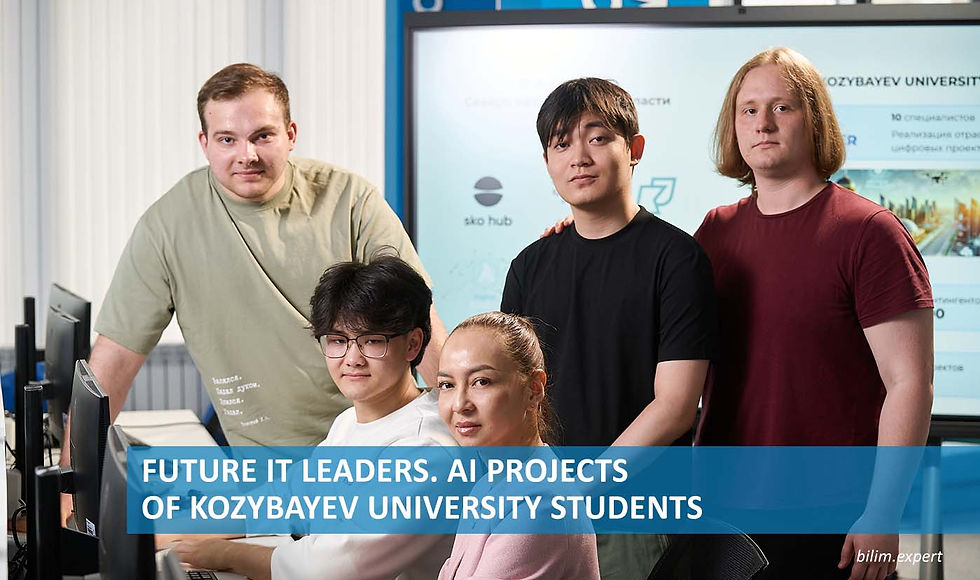
The course toward total digitalization and accelerated development of artificial intelligence, set by President Kassym-Jomart Tokayev, requires a radical restructuring of Kazakhstani universities. To remain competitive, higher education must shift its focus to training AI researchers, engineers, and a new format of IT leaders by actively integrating technology into the educational process and supporting student startups. Kozybayev University, as the hub of university science in North Kazakhstan, strives to be at the forefront of this transformation. Viable IT projects for the region are developed here starting from student years, and the university creates all the necessary conditions for this.
The response to the challenges of our time and the President's initiative was the creation of the Center for Artificial Intelligence and Digital Transformation at Kozybayev University in 2025. Its activities are focused on two vectors – the development of human capital and the design of applied IT solutions for the specific needs of the region.
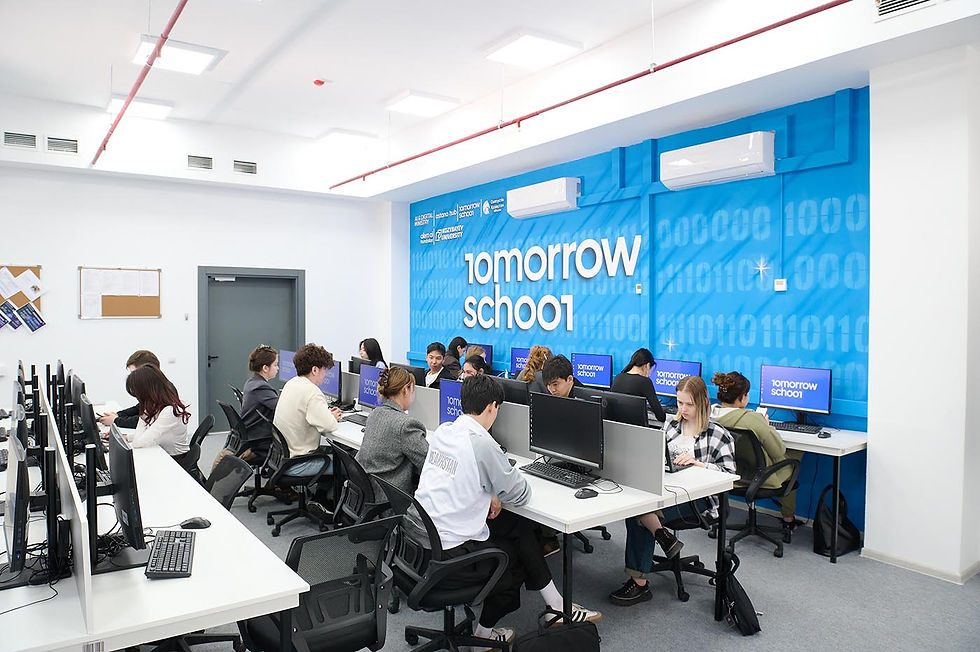
As part of the center's work, and with the support of the Akimat of the North Kazakhstan Region, the regional campus of the Tomorrow School was launched at the university – unique schools of artificial intelligence officially opened by the Head of State. Kozybayev University is among the 15 pilot universities in the country where these schools have been established.

A specific feature of Tomorrow School is the organization of learning based on the peer-to-peer model (learning among equals). Education here is structured without lectures or professors – students develop through teamwork and knowledge sharing. At the same time, they can acquire a high-quality education and upgrade their skills through real-world case studies. The school focuses on the practical study of information systems, artificial intelligence, and coding from scratch. The campus operates 24/7, students design their own schedules, and the training is free for everyone. Thanks to the support of the Akimat of the North Kazakhstan Region, the university gained access to licensed software that covers the full engineering cycle, from basic programming to deep neural learning.
Tomorrow School goes beyond classical learning stereotypes and is a breakthrough project in training IT specialists. Knowledge in the field of AI and information technology helps students adapt and become highly sought-after in the labor market.
Every day, dozens of students who want to gain new knowledge study at Tomorrow School.
– The Center for Artificial Intelligence and Digital Transformation opened in November last year. In a short period, we have already shown good intermediate results, and we continue our work on automating and optimizing the region's ecosystem. Our mission is to develop human capital and create applied IT solutions tailored to the needs of the North Kazakhstan Region, aiming to make the region one of the leaders in digital development, – says Gulnar Kim, Head of the Center for Artificial Intelligence and Digital Transformation at Kozybayev University.

Today, 11 students studying in the IT field work at the center, including those enrolled in dual-degree programs with the University of Arizona. The strategic partnership with one of the leading universities in the US has opened up immense opportunities for the North Kazakhstan university. Already this year, fourth-year students completed their studies at the main campus of the University of Arizona in Tucson. This includes 29 people, the majority of whom are students of the "Information Systems in Management" program.
The students' interest in new technologies, perseverance, and continuous skill refinement have led them to create their own projects. AI agents are already being developed for the advancement of education, transportation, and the social sphere, and projects are being prepared with the major pharmaceutical company AstraZeneca.
All of these cases are not just academic exercises; they are created for specific technical assignments and are immediately integrated into the region's digital ecosystem.
One of the first ready-made IT products was the multifunctional web platform District, developed for the Housing Inspection of the Petropavl City Akimat. The authors were tasked with making the interaction between residents, management companies, and residential complex administrations transparent, reducing operating costs, and improving the quality of service in the housing and utilities sector. The platform is based on iOS and Android.
– Together with two other students, we were developing an AI assistant and a voting module inside this application. We gained our core skills during our studies and also took additional courses at the university. Actually, my interest in studying frontend development appeared back in the tenth grade. I became curious: how does it work? My sister helped me find information. I think that is what determined the choice of my future profession. Now I am studying in the dual-degree program with the University of Arizona, majoring in "Information Systems." It is great that even as students, we already have the opportunity to work in this center, earn money, improve our skills, and gain practical experience in development, analytics, and interacting with clients, – shares Nikita Balashov, one of the product developers.
In parallel, Nikita is involved in creating a digital resource commissioned by the Department of Economic Investigations. This is a website designed to help the department's specialists verify applications for granting subsidies to farmers for field cultivation, based on data analysis of terrain maps considering soil and climate factors.
The theme of regional security and logistics formed the basis of another important project of the center – a mobile platform for the "Senim Zhol" project, being developed jointly with the Petropavl Police Department. This is a centralized, cross-platform information system designed to automate intercity passenger transportation. It aims to streamline the interaction between passengers, drivers, taxi fleet administrators, and law enforcement agencies.

Another request came from the Prosecutor's Office of the North Kazakhstan Region. To identify dangerous road sections and provide recommendations to responsible agencies based on accident data analysis, students Oksana Leontyeva and Maksim Polyakov are preparing a website with an interactive map of road accidents in the North Kazakhstan Region using artificial intelligence technologies. The team has developed a decision support system. A specific feature of the platform is its detailed statistics – for example, the dependence of the number of accidents on the time of day, road surface quality, lighting, weather conditions, etc. It also features a heatmap showing the concentration of accidents in specific road areas. By clicking on a cluster of points, users can access information about that section and recommendations for improving the situation.
– Our map will help identify dangerous areas on the roads in advance, thereby preventing traffic accidents. Currently, we are at the data collection stage. We need road certificates and traffic intensity data; it is crucial to know literally every sign on any given section. The main difficulty lies in obtaining up-to-date information. For our analysis, we are using the International Accident Index. After that, we will refine the artificial intelligence module, which will output recommendations for the services – whether to widen a section of the road, install rumble strips, add or remove a traffic sign, and so on, – shared Maksim Polyakov.
The socially significant project "Development of the Software Package 'AI Legal Consultant for Convicts'" is being carried out jointly with Soilephone LLP, with which Kozybayev University has signed a cooperation agreement. It is designed to ensure equal, secure, and controlled access for convicts to up-to-date legal information within the institutions of the penitentiary system.
Specialists from Soilephone LLP have already designed and implemented a secure communication platform – video payphones – in 13 such institutions, aiming to solve the problem of social isolation among convicts, reduce tension, and ensure prisoners' rights. Thanks to the joint development with Kozybayev University, convicts will also have an additional opportunity to access legal information and explanations of statutory norms in an adapted format via these video payphones.
The development will help reduce legal illiteracy and minimize conflict situations stems from a lack of understanding of rights and duties. The AI consultant will provide reference information on legislation, offer application templates (without providing legal representation), and explain procedures – such as filing complaints and petitions, parole, transfer to alternative confinement conditions, and arranging visits and deliveries.

Student developer Yelnur Ayagan notes:
– There was an issue regarding convicts' quick access to up-to-date information from the criminal and criminal-executive codes, as it is updated with a certain periodicity. We proposed integrating an artificial intelligence module into the video telephony devices. It operates as several agents, each with its own role, based on a chat principle. Currently, we are working on making it voice-activated. For now, we have developed the functionality. On June 1, we plan to launch the devices with our agents in several institutions, and then the prototype will be refined over the course of a month.
The Scroll project by Timur Mukashev, a student in the dual-degree program with the University of Arizona, is dedicated to optimizing departmental processes. Scroll is a specialized web chatbot for the Police Department of the North Kazakhstan Region. Its main goal is to provide citizens with automated answers based exclusively on official, up-to-date documentation. A key feature of the solution is the strict isolation of the knowledge source: the bot operates only with the data uploaded by administrators through a closed control panel. The project has a bilingual interface (Kazakh and Russian) while adhering to the departmental writing style.
– Our product will assist citizens in the legal segment. It will be integrated into specialized display banners installed in institutions, allowing individuals to interact with them directly – obtaining information on vehicle registration, the issuance of license plates, and so on. This is being done to optimize processes within the Police Department. We hope that our bot will bring real benefits and help people, – shares Timur Mukashev.
Projects are being implemented in response to requests not only from government institutions but also from regional businesses. For example, a program for the automatic detection of product defects is being developed with the KDL Raduga company, which manufactures food products and household goods. The analysis is conducted based on production data using machine learning. Currently, students are building a dataset to train the classifier during their internships. The MVP (minimum viable product) will be presented during the students' thesis defenses.
The development of artificial intelligence and digital technologies has become one of the central priorities of the university.
Kozybayev University has been selected as the country's anchor university for the implementation of the AI-Sana program – a national project for the development of artificial intelligence. Today, it ranks among the top 10 universities and is first in Kazakhstan in terms of the number of students who have completed basic courses on the Huawei, Coursera, and AstanaHub platforms – over 11,000 students have received certificates.
Currently, 487 students are enrolled in IT programs, with another 184 studying under the dual-degree program with the University of Arizona. Moreover, the university is building a regional AI ecosystem where the institution becomes a hub for science, knowledge, and collaboration with executive authorities as well as business. Within this synergy, solutions are born that can scale tomorrow and lead to the sustainable development of the region, the growth of human capital, and the formation of a new technological future for Kazakhstan.
ANNOTATION
Next-generation universities must train specialists capable of working in a digital economy, creating innovations, and confidently responding to the challenges of our time. Kozybayev University consolidates the potential of university science in North Kazakhstan for the accelerated digitalization of the region. Thanks to the conditions created at the university, students are already involved during their studies in creating in-demand IT projects tailored to the specific requests of production and the public sector.


Comments